
Only NLG chapters, committees and projects can apply for a grant. The proposal must be authorized by the NLG entity if submitted by a member on behalf of the chapter, committee, or project.
No, we will not issue grants to individuals. The program is intended for NLG projects and committees. We encourage NLG members who have ideas for proposals to approach their local chapter or a relevant committee. The Chapter or Committee can sponsor the proposed project and, if selected, would be the one to administer the grant.
No, we do not issue grants for general support, only for specific projects or programs.
Grants will range from $500 to $7,500. We have a limited pool of funds to make these grants and want to ensure the greatest impact for as many groups as possible. We realize it is a relatively small amount, especially for projects that involve hiring staff. The grants program is intended to provide limited supplemental funds that could potentially make a difference in a group's ability to do work that will benefit the Guild as a whole. Despite the great need, we unfortunately do not have the resources to fully fund or sustain the many worthwhile projects that are out there.
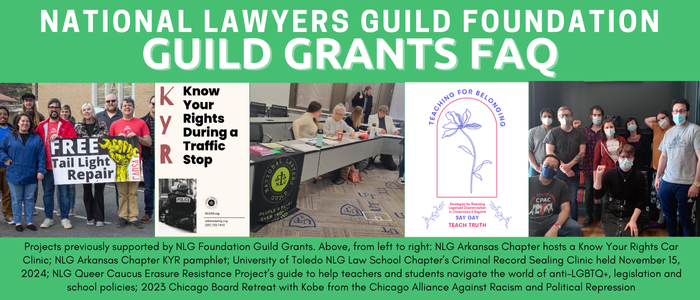
Funded projects must advance the mission of the NLGF to promote human rights and the rights of ecosystems over property interests. Examples of past funded activities include data collection or research, Legal Observing, website upgrades, production of legal resources, provision of legal services, outreach, trainings, educational forums, and CLEs. Past grant recipients can be found at nlg.org/nlgf/grants.
We are interested in funding projects that will strengthen the Guild by increasing your chapter or committee’s membership and capacity. Projects must also further the NLG Foundation’s mission of promoting human rights and the rights of ecosystems over property interests.
To be eligible, applicants must be an NLG chapter, committee or project with a bank account bearing a National Lawyers Guild-related name. Law school chapters who receive funding through their school do not need their own bank account.
These grants are not intended for general support or for the National Office, National Immigration Project, NPAP, or the Sugar Law Center.
Yes, you can submit multiple proposals from different committees or for different projects or areas of work within a chapter or committee. If using the same email address to submit multiple proposals, there will be a link after your first submission asking if you want to submit another response.
Typically, an officer or representative of the chapter or committee submits the application. However, any member authorized by your group’s governing body can fill out the form if they have all the information needed and would be able to answer any questions about the request.
A sponsor is an NLG entity that agrees to be responsible for the grant (serving as point person for communications, signing for and accepting funds, administering and tracking expenses, taking legal responsibility for the project, filing any necessary taxes, and submitting reports)
Applicants can submit a proposal by filling out the application form before the published deadline. The form asks you to summarize your proposal and tell us how a grant would increase the capacity, long-term growth, and membership of your chapter or committee; how you plan to coordinate across the Guild; who will implement the project; what your fundraising efforts are like; and what your project’s expected income and expenses are. We may reach out to you with follow up questions if needed. The selection committee will carefully review each proposal and rate each according to specific criteria:
- Will the project increase capacity and build the NLG?
- Will the project promote membership - especially in smaller, less resourced, geographically diverse chapters?
- Will the project enhance coordination among Guild chapters, committees and the National Office?
- Is there financial need and demonstrated capacity to raise matching funds?
- Does the applicant have the ability to carry out the proposed project (is there a record of success, adequate administrative oversight, etc.)
Whether or not an individual application receives funding can depend on the quantity and quality of all the applications received. The selection committee reviews and rates each application based on the criteria and the scores are averaged and weighted to provide a final ranking. Grants are generally distributed in order of ranking until all funds are expended. Recipients will be notified in December and asked to sign a grant agreement, provide a W9, and submit any past due reports before we can issue the check.
Yes, you can reapply for additional or new funding but one of the overarching goals of the grants program is to strengthen the Guild as a whole, which includes distributing resources as broadly as possible. Accordingly, newer or previously unfunded chapters or committees are more likely to receive funding.
We know it can be tricky to predict future expenses for a project. The budget should include your anticipated expenses for the project based on the activities you intend to conduct with the grant funds. For example, if you are planning to host an event, think about how many participants you want to come and what you will need to do to host that many people. If you have an outreach list of 500 really engaged people, maybe 5-10% will come, so you will need to plan for 25-50 attendees. Think about if you will need to rent space to host the event, how much it would cost to create flyers, whether or not there will be a speakers fee, etc. If you are planning to hire part-time help to do the project, think about how many hours it will take and what the hourly pay would be. Be sure to include any other personnel-related expenses you may have as well.
We can only fund expenses related to the proposed project. We cannot provide grants for general support or “rainy day” funds.
For your income, be realistic about how much you hope to raise in addition to the grant request. Create a list of possible sources (e.g. NLG Foundation Grant, other foundation grants, individual donations, portion of membership dues, event tickets or registration fees, benefit party proceeds, merch sales, etc.) If your anticipated expenses exceed your expected income then you will need to think about other ways to raise money and/or pare down your expenses to include only what is absolutely necessary to complete the project.
Grant recipients must submit a progress report every six months describing the manner in which the funds have been spent, including a financial report of expenses made, and the progress made in accomplishing the purposes of the grant. Grantees with overdue reports in will not be allowed to apply for another grant or receive any additional funding from us until the reports are completed. If you do not report on your progress you will need to return the grant funds.
No, the grant is intended to be used as needed throughout the course of the project. If the project is cancelled or if no progress is made on the grant after a number of years we may ask you to return any unspent funds.
Small changes in the budget (e.g. spending $100 on copies instead of office supplies) usually do not need pre-approval as long as the expenses are in line with 501c3 requirements and don’t change the goals of the project. If you are unsure, or if you need to re-purpose the grant or change the scope of the project, please contact us for guidance or approval. As long as the new plans still meet the Foundation’s goals of strengthening the Guild we are usually happy to alter the grant terms as needed.
Absolutely! Please feel free to email nlgfoundation@nlg.org with any questions.